
The Problem With Fixed-Geometry Turbos
In the previous section, we looked at the basic operation of a fixed-geometry turbocharger and the compromise between low-speed response and high-speed airflow.
But there is another problem we need to consider.
What happens when the turbocharger produces more boost than the engine needs?
Remember, the turbine is driven by exhaust gas. The more energy available from the exhaust, the more energy can be transferred to the turbine and compressor.
As engine speed and load increase, the turbocharger can accelerate and produce more boost.
But we can’t simply allow boost pressure to increase without limit. The engine, turbocharger and intake system all have operating limits.
So how do we control it?
Enter the Wastegate
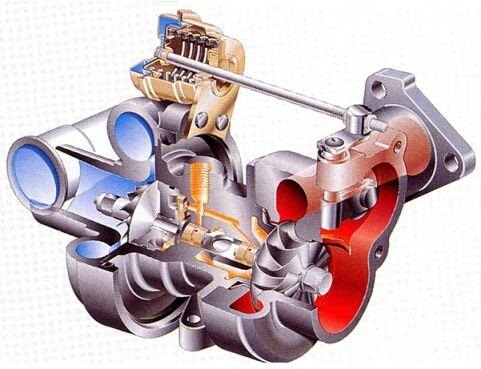
One solution is to fit a wastegate.
A wastegate is essentially a valve that allows some exhaust gas to bypass the turbine instead of passing through it.
Think back to how the turbo works:
- Exhaust gas passes through the turbine and makes it spin.
- The turbine drives the compressor through the connecting shaft.
- The compressor forces more air into the engine.
Now imagine we open a second route for some of that exhaust gas.
Instead of forcing all the exhaust through the turbine, we allow some of it to go around it.
Less exhaust energy passes through the turbine, helping to limit how quickly the turbocharger spins and how much boost it produces.
In simple terms:
Wastegate closed: More exhaust gas passes through the turbine.
Wastegate open: Some exhaust gas bypasses the turbine.
The wastegate doesn’t stop the turbo from working. It simply diverts some of the energy that would otherwise drive it.
Does That Solve the Problem?
Not entirely.
A wastegate can help control maximum boost, but it doesn’t change the size or geometry of the turbine passages.
Remember our original compromise?
A smaller turbo can respond quickly at low engine speeds, but may struggle to flow enough air at high engine speeds.
A larger turbo can flow plenty of air at high engine speeds, but may take longer to spool up at low engine speeds.
“A wastegate doesn’t eliminate that compromise.”
It gives us a way to control the turbocharger, but it doesn’t make a large turbine behave like a small one when exhaust flow is low.
A Volvo Example – The D13A
Another way to manage boost is through fuelling strategies, as is the case with the Volvo D13A configuration, which has neither a wastegate nor a VGT.
So, how does it manage boost without either of these mechanisms?
Remember, the turbocharger is driven by energy from the exhaust gases. The ECU controls how much fuel is injected into the engine, which influences the energy released during combustion and, in turn, the energy available in the exhaust to drive the turbocharger.
More fuel, under the right operating conditions, can mean more exhaust energy, greater turbocharger speed and more boost.
But what happens if the boost pressure exceeds the permitted limit?
The ECU monitors boost pressure and other engine operating conditions. If boost exceeds the permitted limit, the ECU can limit fuel delivery to reduce engine output and help bring the turbocharger back within its operating limits.
Notice the difference here.
The ECU isn’t opening a valve to divert exhaust gas around the turbine, as a wastegate would. Nor is it moving vanes to change the turbine’s geometry, as a VGT system does.
Instead, it influences the energy driving the turbocharger by controlling the fuel going into the engine.
It’s controlling the engine’s output to manage the turbocharger’s operating conditions, rather than directly controlling the turbocharger itself.
Of course, fuelling strategies have their limitations. Reducing fuel can limit engine power, and it doesn’t give the turbocharger the ability to adapt its turbine geometry to suit different engine speeds and loads.
And that leaves us with a couple of interesting questions.
What if we could change the way exhaust gas flows through the turbine, depending on what the engine needs?
What if we could improve turbo response at low engine speeds without restricting the turbo’s ability to flow large quantities of exhaust gas at high engine speeds?
That’s exactly what a variable-geometry turbocharger (VGT) is designed to do.