⚒ Pre-LIN: The “Hardwired” Era
To understand why LIN is a “clever solution,” we have to look at what came before it. In older systems, every single switch and lever is hardwired directly to an ECU.
- The Logic: When you flipped a switch, it physically sent a ground (negative) or a voltage (positive) signal to a specific pin on the main ECU.
- The Protection: These systems are a step up from basic fuses; the ECU’s Internal Circuits (ICs) were short-circuit protected. If a wire shorted, the ECU simply shut that “gate” until the fault was fixed. No more replacing dozens of blown fuses!
- The Problem: Imagine a modern driver’s door. Between the window switches, mirror adjustments, and locks, you would need 20+ wires running through that door hinge. The wiring looms became thick, heavy, and prone to breaking from constant flexing.
🎓 LIN systems: A clever solution
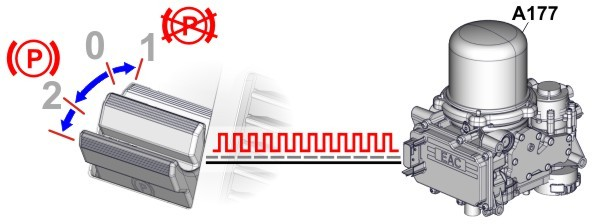
LIN (Local Interconnect Network) is the “brilliant evolution” designed to thin out those massive wiring looms. Instead of a switch being a “dumb” piece of plastic that completes a circuit, LIN turns a switch panel into a small, smart ECU, often called “Sub-Hardware.”
The 3-Wire Standard: Almost all LIN components share a simple 3-wire “bus”:
- Positive (+): Power supply for the unit (usually 12v in Volvo Trucks).
- Negative (-): Ground (usually spliced locally to the chassis).
- Signal: The digital “talk” line.
The “Aha!” Moment: Instead of 20 wires for 20 buttons, we now use one Signal wire to tell the main ECU everything. When you press “Window Down,” the switch panel sends a digital data packet over that signal wire saying: “Button 4 pressed.”
👯♂️ Master and Slave: Zone-Based Control
In a LIN setup, we use a “Parent/Child” (or Master/Slave) relationship.
- The Parent (Master): A main ECU (like a Cab Module or Door Module).
- The Slave: The LIN switch panel or a small motor (like a mirror adjuster).
The Benefit for Technicians: Manufacturers group these into Zones. For example, a “Security Subnet” (Volvo) or “Antitheft Network” (Mercedes) might group the alarm siren, movement sensors, and door locks.
If a fault occurs, the Parent ECU can often isolate that specific “Zone” or power group. Instead of dismantling the entire interior to find a short, your diagnostic laptop might point you directly to the “Right Side Cab Supply.” You’re looking at a square meter of the truck instead of the whole vehicle.
💡 Why LIN is “Expansion Ready” (Plug & Play)
One of the coolest features of LIN is how it handles upgrades. Because the Parent ECU is already factory-programmed with the “logic” for every possible feature, adding an option is often as simple as plugging in the hardware.
- Add the Component: Plug in a new LIN-enabled switch.
- The Handshake: When the ignition turns on, the Parent ECU sees a new “ID” on the LIN line.
- Activation: The function is enabled automatically. No complex software flashing required—the “brain” already knew how to do the job; it was just waiting for the “fingers” to be plugged in.
🛠 Diagnostics: The Modern Challenge
While LIN simplifies the wiring, it adds a layer of software.
- The “But”: You can no longer just “bridge” two wires at a switch to see if a motor moves. If the LIN switch panel is dead, it won’t talk to the Parent ECU, and nothing will happen.
- The Strategy: This is where DTCs (Diagnostic Trouble Codes) and “Test Parts” become your best friends.
A laptop might tell you “LIN Communication Error with Driver Door Module.” That tells you to stop checking the window motor and start checking the 3-wire LIN bus (Power, Ground, and Signal).
🧠 The “Brain” Behind the Wire
You might be wondering: if all these buttons share the exact same signal wire, how does the ECU know the difference between you wanting to adjust your left mirror or roll down the rear right window?
🪄 It’s not magic, it’s math.
Every time you press a button, that “Sub-Hardware” switch panel sends a very specific digital code (a string of 1s and 0s) down the line. Each function has its own unique “ID.”
🔢Want to see the math under the hood?
If you’re curious about how those digital numbers are built, weighted, and “packed” into a single wire, head over to the Nerd Section to see how we jump from raw electricity to computer language.